August 17, 2026
How to Build Recurring Revenue as a Mobile Detailer: Turning One-Time Details into Monthly Clients
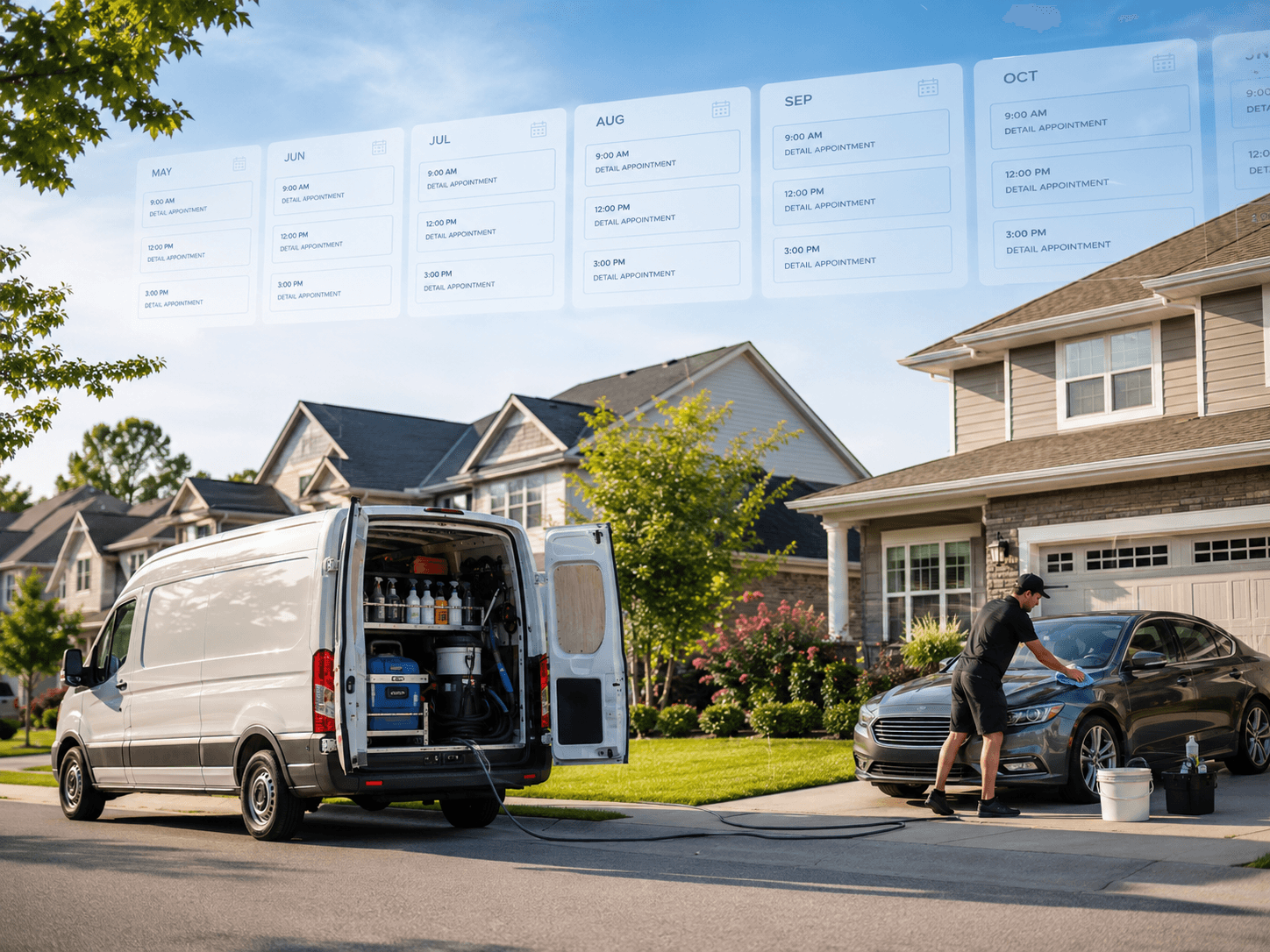
Here's the uncomfortable math of one-time detailing work: every month starts at zero. You can be fully booked in April and staring at an empty calendar in May, because none of April's customers are obligated to come back. So you spend money and energy finding new customers — over and over — to sell them one job each.
The most profitable mobile detailing businesses in 2026 have quietly flipped that model. They sell the second job before they leave the driveway of the first one, and they've converted their best customers onto monthly maintenance plans. Consider the numbers: a $250 one-time full detail is $250. That same customer on a $150/month maintenance plan is $1,800 a year — from one relationship, with zero additional marketing cost. Fifty customers like that is $90,000 a year of predictable, weather-the-slow-season revenue before a single new lead.
This is also where the whole industry is heading. Customers increasingly expect subscription-style car care the same way they expect it from their car wash, their gym, and half the apps on their phone. Here's how to build it.
Design plans people actually want
The core insight: a maintenance plan isn't a discounted detail — it's a different product. The first visit does the heavy lifting (a full detail at full price), and the plan maintains that result. That framing matters for your margins and your pitch.
A structure that works for most mobile detailers:
Monthly Maintenance — the workhorse plan. A maintenance wash and interior refresh every month at a rate meaningfully below your one-off price for the same work, because the car never gets bad again. Example: $99–$150/month depending on vehicle and market.
Bi-weekly or "Executive" plan for the customers who want the car perfect at all times — busy professionals, luxury vehicles, realtors who live in their cars.
Coating maintenance plan for every ceramic coating customer. Anyone who paid $1,000+ to protect their paint is the easiest maintenance-plan sale you will ever make: they're protecting an investment, and coatings genuinely need proper maintenance washes.
Keep it to two or three tiers. A menu of seven plans converts worse than a choice between two.
Price plans for commitment, not charity
Discount the frequency, not your labor rate. A monthly customer costs you nothing to acquire, nothing to market to, fills your calendar predictably, and their car is easier to clean every visit because it never fully deteriorates — that's where the lower monthly price comes from, not from working cheaper. Multi-vehicle households are your best targets; families with two or three cars on one plan retain dramatically better than single-car plans.
Bill automatically on a saved card. A plan that requires you to chase a payment every month is not recurring revenue; it's recurring collections.
The pitch: sell it at the moment of peak happiness
The best time to sell a maintenance plan is the sixty seconds after you finish a full detail, while the customer is circling a car that looks better than the day they bought it. The pitch is one sentence:
"If you'd like to keep it exactly like this, I do a monthly maintenance visit for [price] — I come to you, same as today, and it never gets back to where it was this morning."
No pressure, no brochure. You're offering to preserve something they visibly love right now. Even a 20–30% take rate on that pitch, applied to every full detail you complete, compounds into a serious client base within a year.
The follow-up system for everyone who says "not yet"
Most customers won't commit on the spot — and then never think about you again until the car is filthy. That gap is where recurring revenue actually gets built or lost:
Same-day thank-you text with a photo of the finished car (they'll show it to people — free marketing).
A rebooking nudge at 4–6 weeks: "It's about that time — want me to come keep it fresh?" with a one-tap booking link.
A 90-day win-back for anyone who's gone quiet.
Detailers who automate a simple follow-up cadence roughly double their repeat bookings versus those who rely on customers to remember. Every rebooked customer is another chance to make the plan pitch.
Protect the plan operationally
Recurring revenue has one enemy: friction. If plan visits are hard to schedule, get skipped, or bill inconsistently, churn eats everything you built. Three rules:
Same slot, same week, every month. Route recurring clients into geographic clusters so "first Tuesday" means one neighborhood of back-to-back plan visits — recurring revenue and minimal drive time.
Remind like it's a normal appointment. Plan customers still need the confirmation and reminder texts; a skipped visit is the first step toward a cancelled plan.
Make pausing easy. A customer who can pause for a travel month stays subscribed; one who has to cancel to skip a visit often never comes back.
Past a handful of plan clients, running this on memory and a notes app stops working — repeating schedules, automatic billing, reminders, and per-customer history are exactly what DetailRoam automates for mobile detailers, so a customer says "yes" once and the visits, texts, and payments run themselves every month after.
Start this week: pitch the plan after every full detail, follow up with everyone who hesitates, and cluster the yeses into route days. Twelve months from now, the difference won't just be revenue — it'll be opening your calendar in a slow month and finding it already half full.