August 10, 2026
Mobile Detailing Pricing in 2026: How Much to Charge (and Why You're Probably Undercharging)
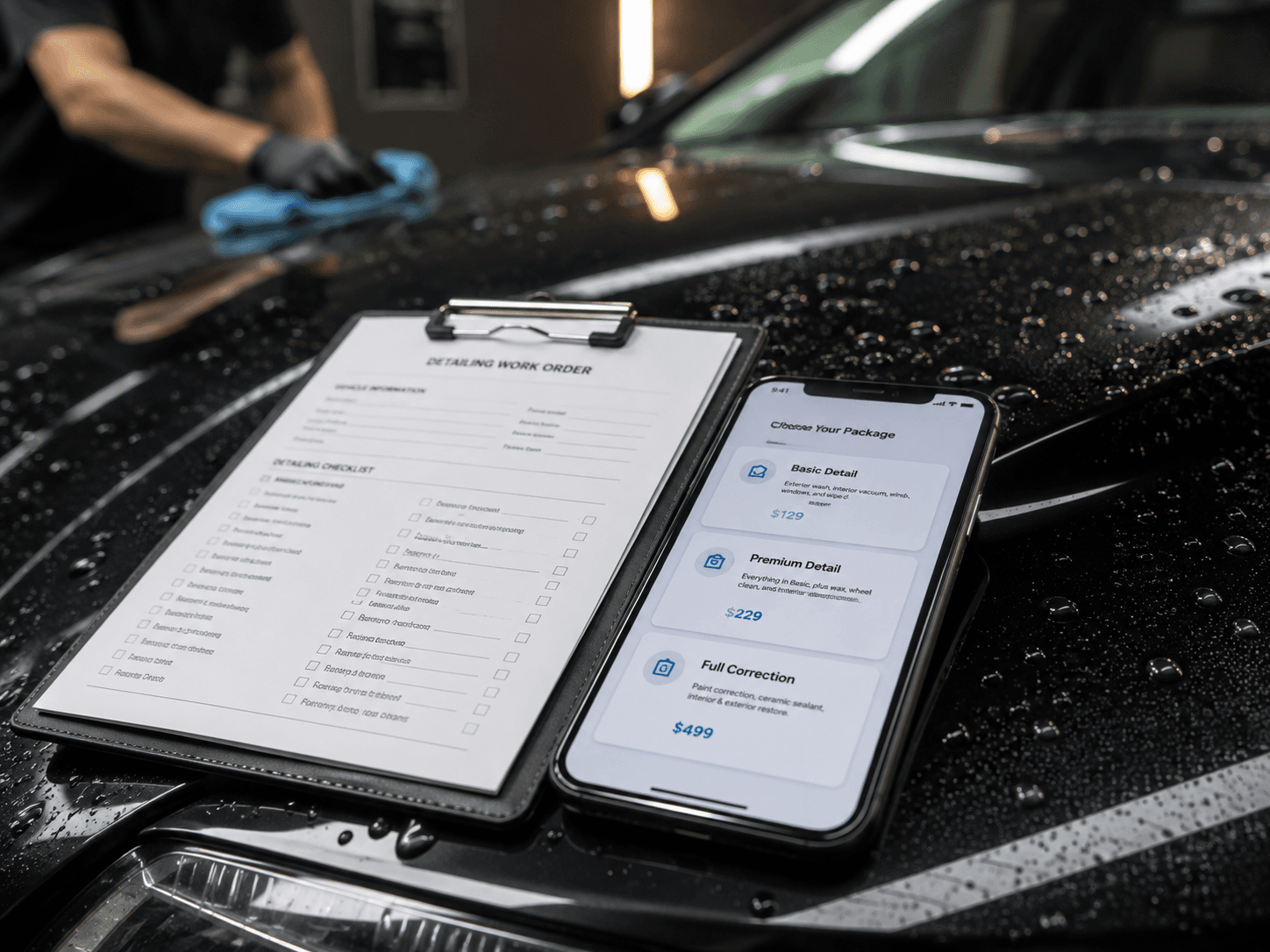
Ask ten mobile detailers how they set their prices and eight will describe some version of the same method: they looked at what other local detailers charge and picked a number slightly below it. The problem is that the other guys did the same thing. Nobody in the chain ever priced from their actual costs — which is how you end up grinding through 5-hour details that pay less than minimum wage after fuel and product.
Here's how to price like a business in 2026.
What the market looks like right now
Current industry benchmarks for detailing services in the US:
Basic wash/maintenance detail: roughly $50–$150 depending on vehicle size
Full interior + exterior detail: typically $150–$500+, with $150–$350 the common range for standard vehicles
Effective hourly rates: most established detailers land between $50–$100/hour
Premium services like multi-stage paint correction and ceramic coating run $600–$1,800+ per job
Those are reference points, not answers. Your number comes from your costs.
Price from your costs, not your competitors
The formula is simple: labor + products + travel + overhead + profit margin = price.
Work through it once, honestly:
Labor. Decide what your hour is worth — not what you'll tolerate, what a skilled trade is worth. If you wouldn't detail someone else's customers for less than $40/hour, don't detail your own for less.
Products. Track what a typical full detail actually consumes. Most detailers who measure land somewhere between $15 and $50 in product per job depending on service level.
Travel. Fuel, vehicle wear, and — the one everyone forgets — drive time. Thirty minutes each way is an hour of your working day. It has to live inside the price.
Overhead. Insurance, software, phone, water, equipment replacement, marketing. Divide monthly overhead by your monthly billable jobs and attach that slice to every quote.
Margin. Healthy detailing businesses target 30–50% net margins. If your price only covers costs, you built yourself a job, not a business.
If the resulting number is higher than the competition's — good. You now know something they don't: their prices lose money.
Charge the mobile premium (you've earned it)
Mobile detailing typically commands 20–30% more than equivalent shop service, and it should. The customer isn't paying extra for the same product — they're paying to skip the drive, the drop-off, the waiting room, and the second car to get home. You're absorbing fuel, drive time, water, power, and setup at every stop. Detailers who price mobile work at shop rates are donating the convenience for free.
Use Good / Better / Best packages
Tiered packages outperform à la carte menus for three reasons: customers understand them instantly, they anchor the middle option as the "reasonable" choice, and they raise average tickets without any selling. A typical structure:
Good — Maintenance Detail: wash, interior vacuum and wipe-down, windows.
Better — Full Detail: everything above plus deep interior cleaning, carpet/upholstery treatment, wax or sealant.
Best — Premium Detail: everything above plus engine bay, headlight restoration, premium protection, trim restoration.
Most customers pick the middle tier. Price it so you're glad they do.
Stop eating condition surcharges
The gap between "well-kept sedan" and "pet-hair biohazard" can be three hours of labor. If your pricing doesn't account for condition, your worst jobs are subsidized by your best customers. Standard, defensible surcharges in 2026:
Heavy pet hair: +$25–$100
Excessive mud, spills, or long-neglected buildup: +$50–$150
Larger vehicles (trucks, three-row SUVs, vans): a size-based bump on every package
Biohazard/mold-level work: its own service entirely, priced from scratch
The key is stating these at booking, not in the driveway. A booking flow that asks about vehicle type and condition up front turns an awkward on-site negotiation into a number the customer already agreed to.
Raise your prices without losing your customers
If you've run the cost math and realized you're underwater, raise prices. The playbook: announce it a few weeks ahead, give existing recurring customers a loyalty rate or a one-cycle grace period, and attach the increase to something visible (new equipment, expanded packages). Expect to lose your most price-sensitive customers and understand that this is fine — a full calendar at unprofitable rates is just tiring, elaborate charity.
Where software fits into pricing
Two pricing mistakes come from tooling, not math: quoting from memory ("uh, probably like $180?") and letting customers book without vehicle or condition info. Presenting fixed, tiered, per-vehicle-type pricing in an online booking flow solves both — the customer self-selects the right package and price before you've spent a minute on the quote. That's how DetailRoam structures booking for mobile detailers: packages, vehicle types, and pricing shown up front, deposits collected on the spot, so every job on your calendar is one you already know is profitable.
Price from costs. Add the mobile premium. Tier your packages. Surcharge honestly. Your competitors are guessing — you shouldn't be.